
Matter can make smart-home devices from different brands work together, but Matter does not force every device to use the same type of network.
A Matter product may connect over Wi-Fi, Thread, or Ethernet. That means two devices can both carry the Matter logo and still behave very differently on your home network.
For most buyers, the practical question is not “Which protocol wins?” It is “Which connection type makes more sense for this specific device and this specific home?”
Quick Answer: Matter Over Wi-Fi vs Thread
Choose Matter over Thread for many low-power smart-home devices such as sensors, buttons, locks, and other accessories that benefit from a low-power mesh network.
Choose Matter over Wi-Fi for devices that already make sense on your home Wi-Fi, especially mains-powered products where higher throughput or simpler infrastructure matters more than ultra-low power use.
Most smart homes do not need to pick only one. Matter is designed so Wi-Fi, Thread, and Ethernet devices can exist in the same Matter fabric.
| Priority | Matter over Wi-Fi | Matter over Thread |
|---|---|---|
| Existing infrastructure | Uses your Wi-Fi router | Needs a Thread network and border router |
| Power efficiency | Fine for mains-powered devices | Designed for low-power devices |
| Network design | Star network through access point/router | Low-power mesh |
| Bandwidth | Higher | Lower, optimized for smart-home traffic |
| Battery devices | Possible, but not always ideal | Often the better fit |
| Setup complexity | Usually simpler if Wi-Fi is already strong | Can require Thread infrastructure |
| Matter controller still required | Yes | Yes |
First: Matter and Thread Are Not Competitors
This distinction matters because the names are often presented as if they describe competing smart-home standards.
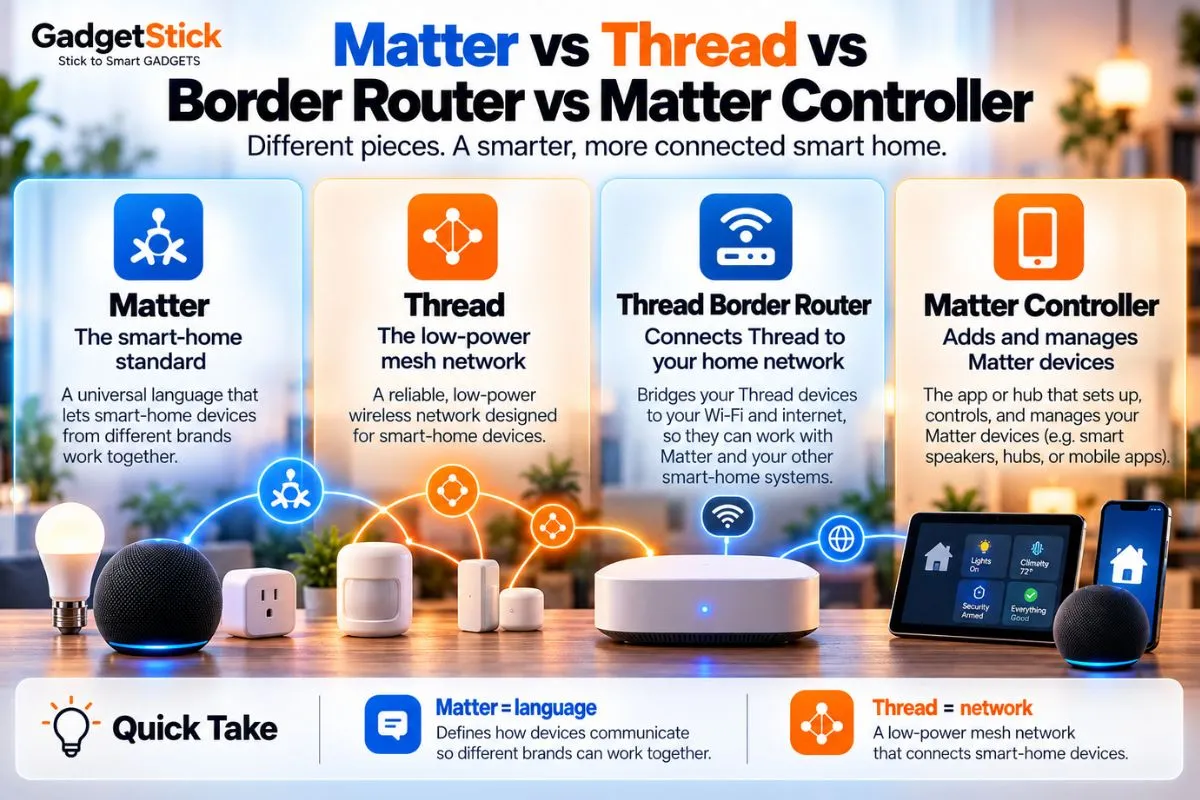
Matter is the application layer — the common language devices use to communicate across compatible ecosystems. Thread is one of the IP-based network technologies that can carry Matter traffic.
The Connectivity Standards Alliance says Matter natively supports Wi-Fi, Ethernet, and Thread, while Bluetooth Low Energy is used during device setup.
Official reference: Connectivity Standards Alliance Matter FAQ.
Thread Group similarly describes Matter as an application standard that can operate over Thread, Wi-Fi, or Ethernet.
Official reference: Thread Group: Thread with Matter.
How Matter Over Wi-Fi Works
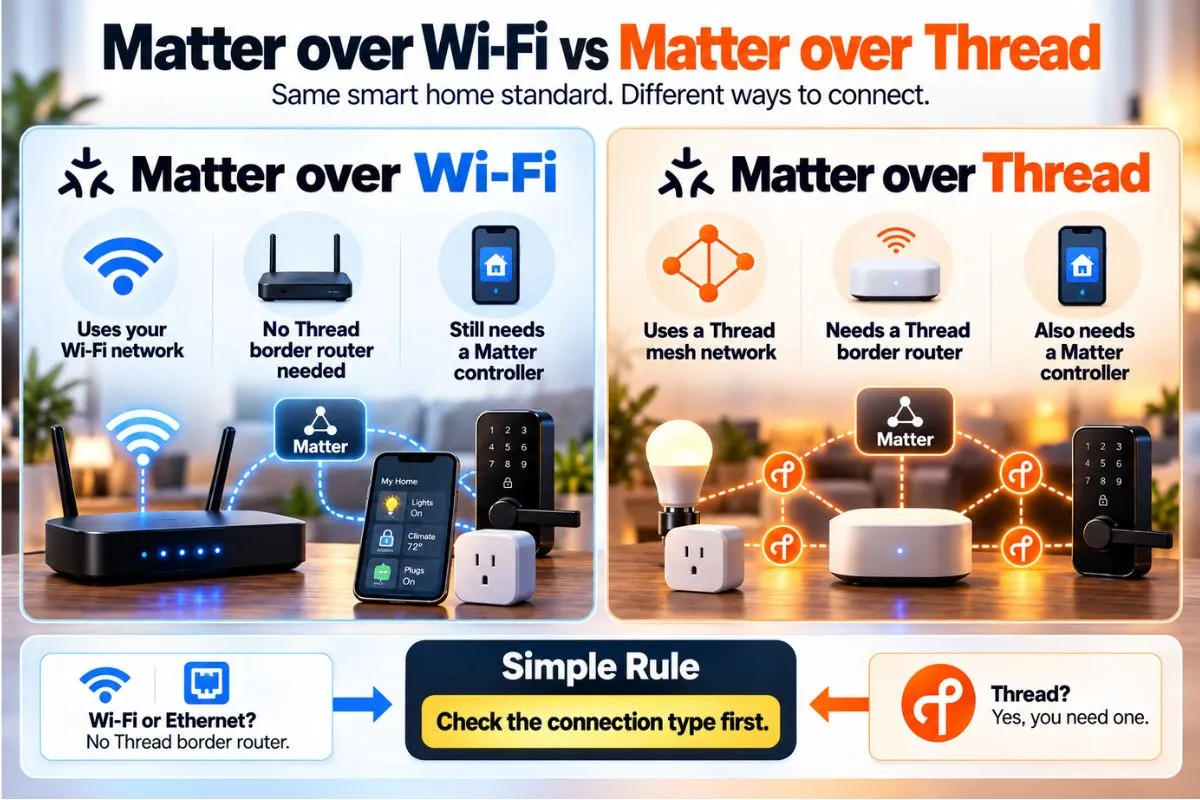
A Matter-over-Wi-Fi accessory joins your normal Wi-Fi network just like many other connected devices in your home.
Your Wi-Fi router or access point handles the network connection, while a Matter controller inside an ecosystem such as Apple Home, Google Home, Alexa, SmartThings, or another compatible platform handles Matter commissioning and control.
You do not need a Thread border router for Matter-over-Wi-Fi devices.
Where Wi-Fi Makes the Most Sense
- mains-powered smart plugs and switches
- devices that already include Wi-Fi hardware
- products that benefit from more network bandwidth
- homes with reliable Wi-Fi coverage and only a modest number of smart-home devices
- buyers who do not want to add Thread infrastructure yet
Wi-Fi is also familiar. Most households already understand how to troubleshoot signal strength, router placement, and network credentials.
How Matter Over Thread Works
Matter-over-Thread devices connect to a Thread mesh instead of joining your Wi-Fi access point directly.
Thread is an IPv6-based, low-power wireless mesh designed for connected devices. Thread Group specifically positions it for low-power smart-home use cases and notes that devices such as sensors can operate with very low energy budgets.
A Thread network needs a Thread border router to connect the Thread mesh to the rest of your IP network in normal smart-home use.
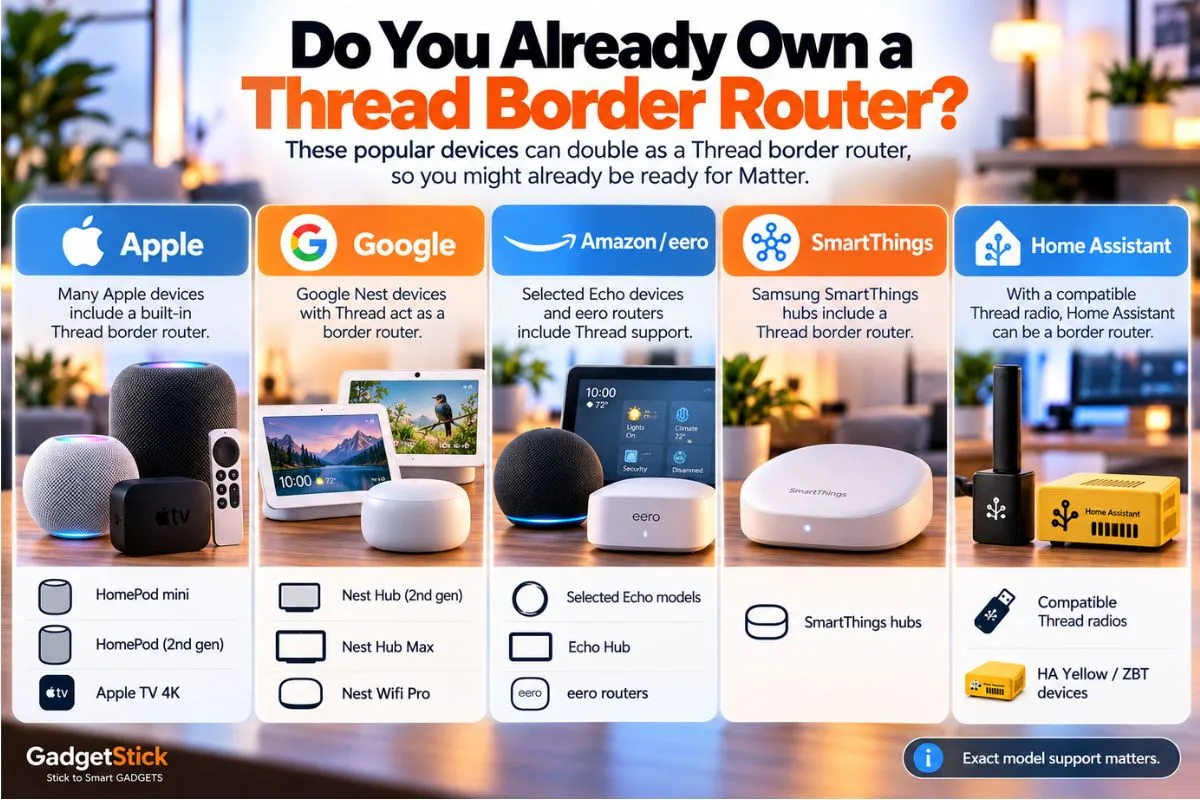
That border router can be built into another device such as a smart speaker, smart display, Wi-Fi router, streaming device, or hub.
If you are unsure whether you already have one, see our guide: Do You Need a Thread Border Router for Matter?
The Biggest Difference: Power Use
Thread was designed with low-power devices in mind.
Google’s Matter developer documentation describes Thread as suitable for nodes such as sensors that may need to run for very long periods on battery power, while Wi-Fi and Ethernet are described as higher-throughput network media.
Official reference: Google Home Developers: Thread and IPv6.
That does not mean every Thread device automatically has excellent battery life, or that every Wi-Fi device has poor battery life. Hardware design, radio behavior, firmware, reporting frequency, and battery size still matter.
But at the network-design level, Thread is the more natural fit for battery-operated smart-home products.
Thread Is a Mesh Network; Wi-Fi Usually Depends on Your Access Point
With Wi-Fi, most smart-home devices communicate through one or more Wi-Fi access points.
Thread is designed as a mesh. Compatible mains-powered Thread devices can help extend the Thread network, while low-power sleepy devices can remain optimized for battery use.
Thread Group highlights self-forming, self-healing behavior and support for multiple border routers as part of the network design.
That can make Thread attractive as a smart home grows, especially when many low-bandwidth devices are spread around the house.
However, mesh does not magically fix bad placement. A Thread network can still have coverage problems if there are too few routing-capable devices or if the border router is poorly located.
Which Is More Reliable: Matter Over Wi-Fi or Thread?
There is no universal winner.
A single Matter-over-Wi-Fi plug located close to a good access point can be extremely simple and dependable. It has fewer pieces in the path because it does not need Thread infrastructure.
Thread becomes more attractive when the home has many low-power endpoints and enough Thread infrastructure to form a healthy mesh.
Thread Group notes that multiple Thread border routers can provide redundancy, reducing dependence on a single gateway.
Official reference: Thread Group: Thread Border Routers.
So reliability depends more on the quality of the network you actually build than the logo on the box.
Matter Over Wi-Fi vs Thread by Device Type
| Device type | Usually better fit | Why |
|---|---|---|
| Door/window sensor | Thread | Low-power, small data packets, mesh-friendly |
| Motion/occupancy sensor | Thread | Low-power and responsive local communication |
| Smart lock | Thread | Battery-focused use case and local mesh connectivity |
| Smart button | Thread | Very low data requirements |
| Smart plug | Either | Wi-Fi is simple; Thread can strengthen a mesh if the design supports routing |
| Smart bulb | Either | Depends on ecosystem, scale, and existing infrastructure |
| Thermostat | Either | Power source and product design matter |
| Camera | Wi-Fi / Ethernet | Video needs much more bandwidth than Thread is designed for |
| Smart display | Wi-Fi / Ethernet | Higher-bandwidth, mains-powered device |
| Large appliance | Wi-Fi / Ethernet | Usually mains-powered with no need for low-power mesh |
These are practical fit recommendations, not protocol rules. Always check the actual product specification because a manufacturer may choose a different transport for a valid reason.
What About Smart Bulbs and Smart Plugs?
These are the gray area.
They are typically mains-powered, so Thread’s low-power advantage is less important. At the same time, permanently powered Thread devices can help create a stronger mesh if they are designed to act as Thread routers.
A few Wi-Fi bulbs or plugs in a home with strong Wi-Fi are not automatically a problem.
But if you plan to deploy dozens of small devices, spreading some of that traffic onto a separate low-power Thread mesh can be attractive.
This is why the answer changes with scale. A five-device apartment and a sixty-device smart home have different network requirements.
Does Matter Over Thread Work Without Wi-Fi?
Thread does not use Wi-Fi as its radio network, but a typical Matter smart home still connects the Thread mesh to the broader home IP network through a Thread border router.
The border router may connect upstream using Ethernet or Wi-Fi depending on the device.
Local Matter control does not inherently require cloud access, but the ecosystem, controller, automations, remote access, and specific product features can introduce other network or internet dependencies. If outage behavior matters to you, see our guide to what smart plugs still do without Wi-Fi or internet.
So “Thread works without Wi-Fi” is too simplistic. The better statement is: Thread is its own wireless mesh and does not make each endpoint join your Wi-Fi network.
Do Thread Devices Slow Down Your Wi-Fi?
Thread devices do not connect to your Wi-Fi access point in the same way as Wi-Fi smart-home devices, so moving suitable endpoints onto Thread can reduce the number of client devices directly associated with Wi-Fi.
That said, simply having many Wi-Fi clients does not automatically ruin a modern network. Router quality, spectrum congestion, traffic patterns, airtime, band steering, and access-point placement all matter.
The real benefit is architectural: Thread gives low-bandwidth smart-home endpoints a network designed specifically for that job instead of putting every device onto the same Wi-Fi layer.
The Hidden Cost of Thread: Infrastructure
Thread can be technically elegant and still be the wrong purchase if you do not already have the required infrastructure.
For Matter over Thread, you normally need:
- a compatible Matter controller
- a Thread border router
- the correct Thread network credentials shared with the ecosystem doing the setup
- enough Thread coverage for the accessory
If you already own a compatible HomePod, Apple TV, Nest device, Echo/eero product, SmartThings hub, or configured Home Assistant Thread setup, that infrastructure may already be present.
If not, buying one inexpensive Wi-Fi smart plug may be simpler than adding a new border router solely for that plug.
Thread 1.4 Makes Multi-Ecosystem Networking More Important
Thread 1.4 focuses on making Thread networks easier to use across manufacturers.
Thread Group says Thread 1.4 standardizes how devices and border routers from different manufacturers recognize and trust one another, with the goal of making Thread networks more interoperable and robust.
Official reference: Thread Group Thread 1.4 resources.
That direction matters because one of Thread’s historical pain points has been homes ending up with separate Thread networks created by different ecosystems.
The long-term goal is less infrastructure fragmentation, but users should still verify the capabilities of their current ecosystem rather than assuming every Thread device will automatically join one unified mesh.
Which Should You Choose If You Are Starting a Smart Home in 2026?
Use this rule: choose the transport that fits the device, not the one with the more fashionable logo.
- For battery sensors, locks, buttons, and similar endpoints, start by looking at Matter over Thread.
- For cameras, displays, appliances, and higher-bandwidth products, Wi-Fi or Ethernet makes more sense.
- For plugs, bulbs, thermostats, and other middle-ground devices, either can work — let your existing infrastructure and ecosystem decide.
- If you already own a Thread border router, Thread becomes easier to justify.
- If you do not own Thread infrastructure and only need one or two mains-powered accessories, Wi-Fi can be the simpler purchase.
When Matter Over Wi-Fi Is the Better Choice
- your home already has excellent Wi-Fi coverage
- the device is mains-powered
- you only plan to add a small number of smart-home products
- the product needs more bandwidth
- you do not own a Thread border router
- you want the simplest possible network path
When Matter Over Thread Is the Better Choice
- the device runs on a battery
- you are adding sensors, locks, buttons, or similar low-power endpoints
- you already own compatible Thread infrastructure
- you want a low-power mesh designed for smart-home traffic
- you plan to grow to many small smart-home devices
- you want multiple border-router redundancy where supported
Common Buying Mistakes
Assuming Thread Is Automatically Better Because It Is Newer
The best network depends on the device. A camera does not become better just because it uses a low-power protocol that was never designed for video.
Assuming Every Matter Device Uses Thread
Matter supports Wi-Fi, Thread, and Ethernet. Always read the connection specification.
Forgetting the Border Router
A Matter-over-Thread accessory can be a frustrating first purchase if you discover afterward that your home has no compatible Thread border router.
Assuming Wi-Fi Is Always Bad for Smart Homes
A well-designed Wi-Fi network can handle smart-home devices perfectly well. The point of Thread is not that Wi-Fi is broken; it is that low-power IoT devices have different networking needs.
Buying Everything on One Protocol
A mixed Matter home is normal. Matter exists partly so devices using different IP transports can still work together at the application layer.
Frequently Asked Questions
Is Matter over Thread better than Matter over Wi-Fi?
Not universally. Thread is usually the stronger fit for low-power battery devices, while Wi-Fi is often simpler for mains-powered and higher-bandwidth products.
Does Matter over Thread need a Thread border router?
Yes, for normal smart-home use a Matter-over-Thread device needs access to a compatible Thread border router.
Does Matter over Wi-Fi need a hub?
It does not need a Thread border router, but it still needs a compatible Matter controller. That controller may be built into a smart speaker, hub, display, router, or another ecosystem device.
Can Wi-Fi and Thread Matter devices work together?
Yes. Matter is designed to operate across IP networks including Wi-Fi, Ethernet, and Thread.
Is Thread faster than Wi-Fi?
That is not the useful comparison. Wi-Fi offers much more bandwidth. Thread is optimized for low-power, low-bandwidth smart-home communication and responsiveness.
Is Thread better for battery life?
Thread is designed for low-power devices and is generally the more natural networking choice for battery-operated smart-home endpoints. Actual battery life still depends on the product design and usage.
Can a smart home use both Wi-Fi and Thread?
Yes. In many homes, that is the most sensible setup.
Final Answer
Matter over Wi-Fi and Matter over Thread are not two competing versions of Matter. They are two different network paths underneath the same smart-home standard.
Thread is usually the better fit for low-power endpoints such as sensors, buttons, and locks. Wi-Fi is usually the simpler fit for mains-powered or higher-bandwidth products, especially when your home already has strong Wi-Fi coverage.
The best Matter home will often use both.
Before buying, check three things: how the device connects, whether you already have the required infrastructure, and whether that transport matches the device’s job.
How We Researched This Guide
We reviewed current documentation from the Connectivity Standards Alliance, Thread Group, and Google’s Matter developer documentation to verify how Matter uses Wi-Fi, Thread, and Ethernet, how Thread handles low-power devices, and why Thread border routers are required for normal Matter-over-Thread deployments.
We also compared current 2026 search results and user-intent patterns around “Matter over Wi-Fi vs Thread” to make sure the guide answers the practical buying questions people are actually asking rather than only explaining protocol theory.
This article does not claim that one transport is universally faster, more reliable, or better for every device. Those outcomes depend on the product, network design, firmware, home layout, and ecosystem.
Editorial Note
Matter and Thread continue to evolve. Device capabilities can change with firmware updates, and Thread infrastructure differs by model and generation. Always verify the exact product before buying specifically for Wi-Fi, Thread, or border-router support.
